
App generation Internal tool
Genny
Generate a Go and Vue application, then keep building in ordinary source code.
Genny is private and pre-1.0. Public access and release dates have not been announced.
From a model to a working screen
A place to keep a few ideas.
For this local example, Genny received an Idea model with a title and some notes. It generated the storage, API and screens for adding, opening and editing records.
The model input
genny models add Idea title:string:display notes:textThe generated API
GET /api/ideas
POST /api/ideas
GET /api/ideas/:id
PUT /api/ideas/:id
The generated edit screen
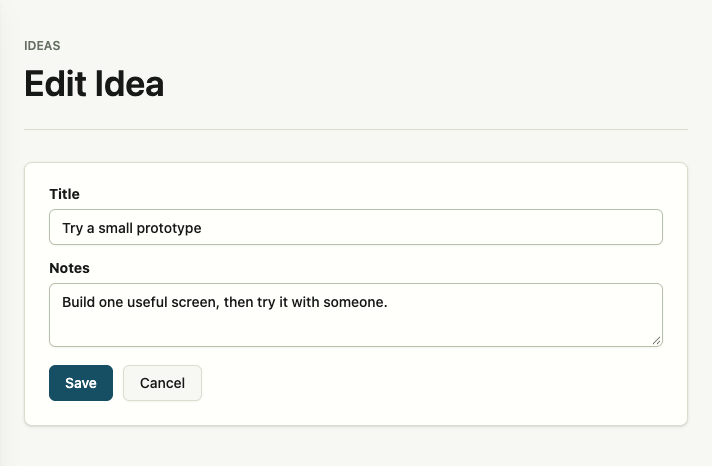
The generated page is a starting point. I can change its layout, add validation or decide what happens when an idea becomes a project. Those decisions stay in the application’s own code.
Follow one idea through the application.
The screen and API work with the same stored records. Follow an idea through creating, reopening and saving later changes to check how those parts work together.
Write it down
Give the idea a title and some notes, then save it. The application creates a record that can be opened again.
Come back to it
Open the saved idea from the list. Its identifier connects the list, the edit screen and the API to the same record.
Develop the thought
Change the notes and save again. Check that reopening shows the new text and that the title still belongs to the same idea.
Then ask a product question.
Suppose this grows into a shared ideas board. What should happen when someone turns an idea into a project? I would first decide whether the original stays available, what information carries over and who may do it.
The application’s decision
The transition belongs in project-owned behavior and tests. The generated CRUD gives us records to work with; it does not decide what “becomes a project” means.
The generator’s connections
Refreshable files marked .gny connect models, services and routes. I use the supported generator commands for that wiring and keep the product rule in the editable source.
What I would check before sharing it.
Create, reopen and edit with ordinary and empty input; check what happens when saving fails; decide who may read and change each record. A working edit page answers part of the question. Access rules, error handling and the product’s own behavior still need deliberate choices.
A starting point you can keep changing.
Genny brings together a Go HTTP server, a Vue frontend, a Tailwind theme and database migrations. It is aimed at developers who want a working application structure while keeping product decisions in code they can read and edit.
I built Genny so recurring application conventions can live in tools. That gives me a consistent starting point while I work out how the product itself should behave.
I wrote about that boundary using a booking example, alongside a rather different example from music.
The decisions I put into tools instead of AI prompts